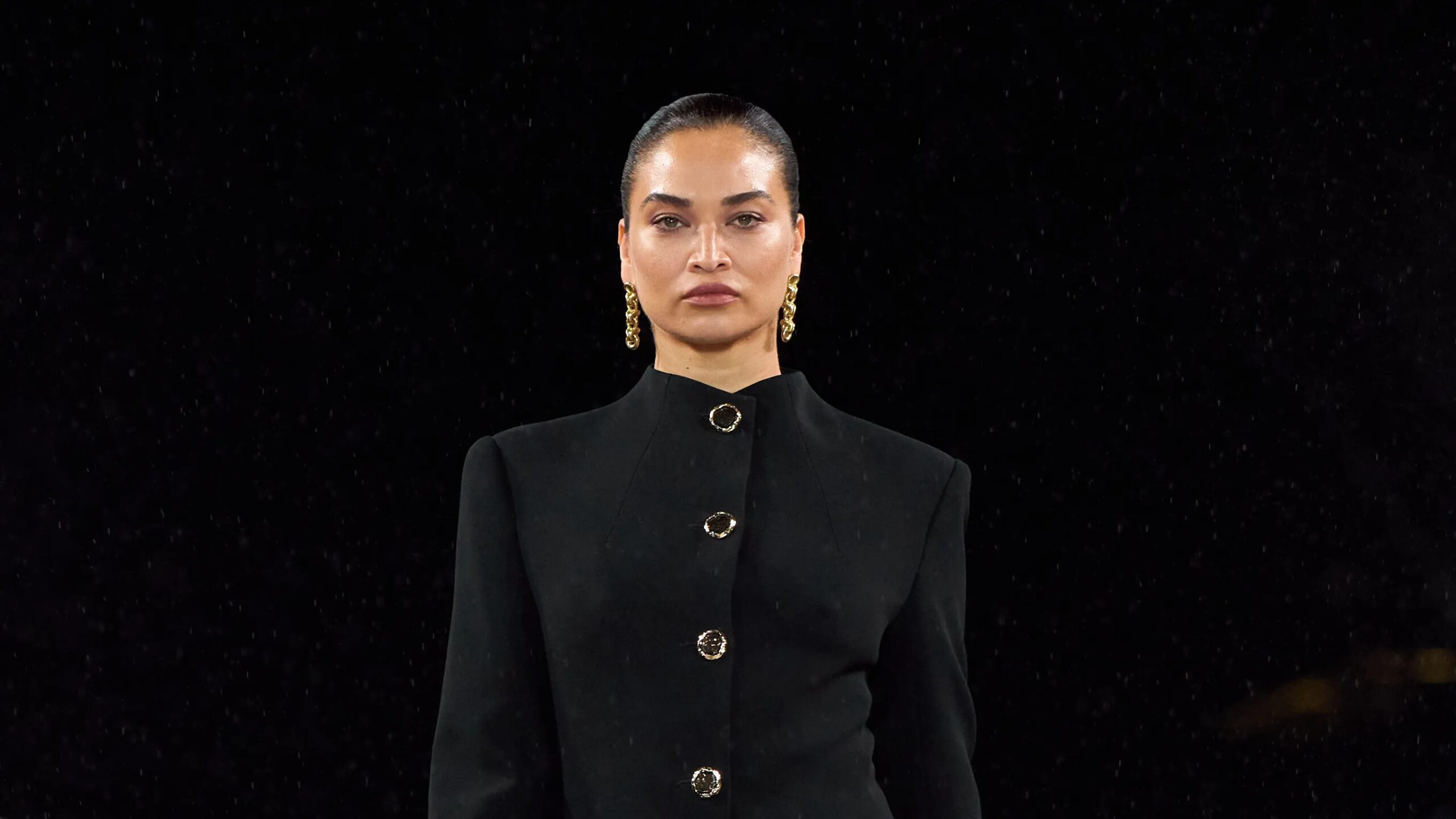
One year after arriving at Dior, Jonathan Anderson staged his first cruise show as a love letter to Hollywood and the power of dreams and illusion.
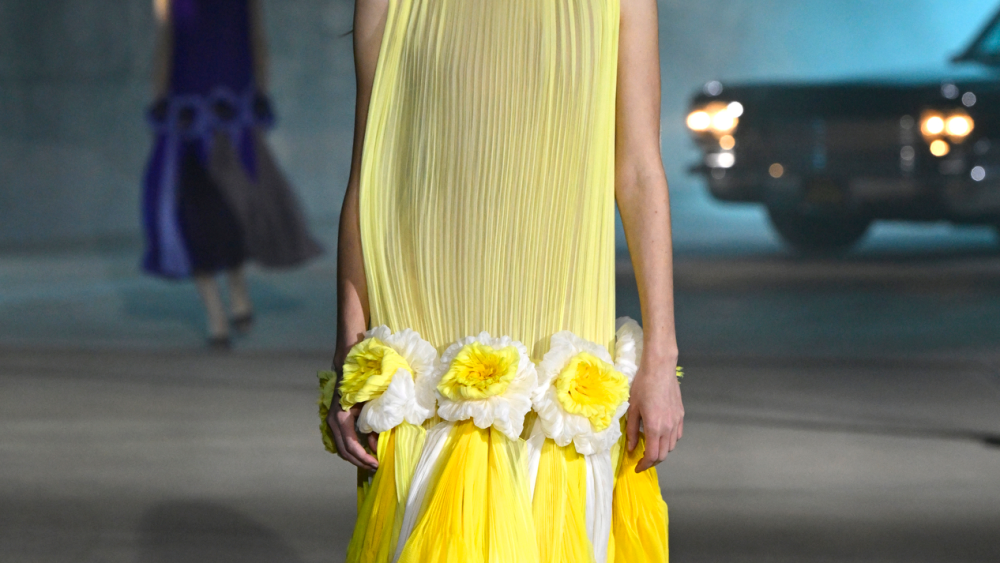
The show took place against a moody cinematic landscape of ridged concrete, drifting smoke and sunset haze on Wednesday evening at the newly opened David Geffen Galleries at the Los Angeles County Museum of Art, where a 75-look lineup of flowing women’s dresses, belted outerwear and new takes on the Bar jacket — stretched to mid-thigh with fringing at the hem — were mixed with men’s tailoring. The collection seemed even more focused than in the past as Anderson continued to hit on the recurring elements that are becoming his signatures at the house, from the use of flowers and feathers to word play and a more youthful, relaxed spin on Dior icons.
Before the show, Anderson spoke repeatedly about cinema, imagining the collection as a cast of characters caught between fantasy and reality.
“I was looking at the idea of on-screen, off-screen,” he said.
The collection became an opportunity for the designer to fulfill a few dreams of his own.
“I’ve always wanted to work with Ed Ruscha,” he said, bringing the artist into Dior’s world through a series of shirts inspired by American iconography and midcentury Americana. He also enlisted Irish hat designer Philip Treacy, someone he’s admired since his student days.
“It was my dream to work with him,” Anderson said of Treacy, whose sculptural feathered headpieces appeared on the men’s looks, spelling out “Dior” and “Buzz” like props. Other men’s styles echoed the women’s, with relaxed tailoring.

Dior Cruise 2027 Collection
Giovanni Giannoni/WWD
The show opened with fluttering dresses inspired by Californian poppies, beginning with a pale primrose-yellow look wrapped in oversized floral accents — also worn front row by Sabrina Carpenter — followed by pale blush and vivid red-orange dresses layered with petal-like details.
As the soundtrack nodded to Hollywood stardom with songs like Linda Scott’s “I’ve Told Every Little Star” and Air’s “Kelly Watch the Stars,” Anderson moved into softened tailoring, and reworked denim inspired by Dior’s 1950s textiles.
The designer described wanting to “redo denim,” working with Dior’s Japanese supplier to embroider jeans with fine silver chains, while woven treatments created faded effects directly through the yarn that resulted in a pilled effect rather than flat cloth. Elsewhere, vertically striped coats referenced Alfred Hitchcock films, where, Anderson noted, “he uses a lot of blinds” as lighting technique. The show’s staging played with similar effects, casting dramatic shadows across the museum’s stark architecture.
Old Hollywood echoed throughout the collection and the set, where vintage Cadillacs appeared alongside flashes of shimmer from new versions of the Saddle bag, heels embellished with flowers or feathers, sparkling sunglasses and sequined details. The influence traced back to Christian Dior’s own relationship with cinema in the 1950s, when the couturier dressed stars including Ava Gardner, Marilyn Monroe and Marlene Dietrich. Anderson became particularly fascinated by Hitchcock’s film noir “Stage Fright” and Dietrich’s costumes for the film, revisiting a historic take on the Bar jacket Dior originally created for the actress. It was during the negotiations to have her star in the movie that Dietrich uttered the famous phrase, “No Dior, no Dietrich,” which Anderson has resurrected in various ways during his tenure.
“We had never had it until this year, because [Azzedine] Alaïa owned the original, the very first prototyping of it,” Anderson explained of the white jacket with its sharp black collar, pulled into the waist without the usual side padding.

Dior Cruise 2027 Collection
Giovanni Giannoni/WWD
The designer hinted at what’s next for Dior in film, framing the L.A. show as the beginning of a larger Hollywood project for the house.
“It’s part of a kind of broader picture of what we will do over the next 12 months in cinema,” he said, noting upcoming film productions tied to Dior, including one with director Luca Guadagnino.
“There might be three more costuming movies, one will be with Luca, and there will be two others,” Anderson went on without providing details.
He’s curious to explore: “How does a fashion house work with cinema, and how does cinema work at the fashion house? What is a new type of business model within that?”
A year into his time at Dior, Anderson spoke about inheriting a brand people project onto in deeply personal ways.
“Dior means so much to different people in different ways,” he said. “People have these emotional attachments to it.”
He’s “just learning,” he continued. “I’m not in any rush. I’m sure business people are in a rush, but money will come. And it does, which is great. It’s a product of being Dior. Dior is a big enough name no matter who goes into it.”
The challenge is balancing Dior’s heritage with a new direction. But he’s confident.
“I know where it’s going,” Anderson said. “Not in a kind of arrogant way. I know where it’s going in terms of where is the process, you know? There’s a process in designing, and there’s a process in discovery…And I’m enjoying the process of it.”
Smiling, he added, “And we’re in L.A., the weather’s good. Get a tan.”