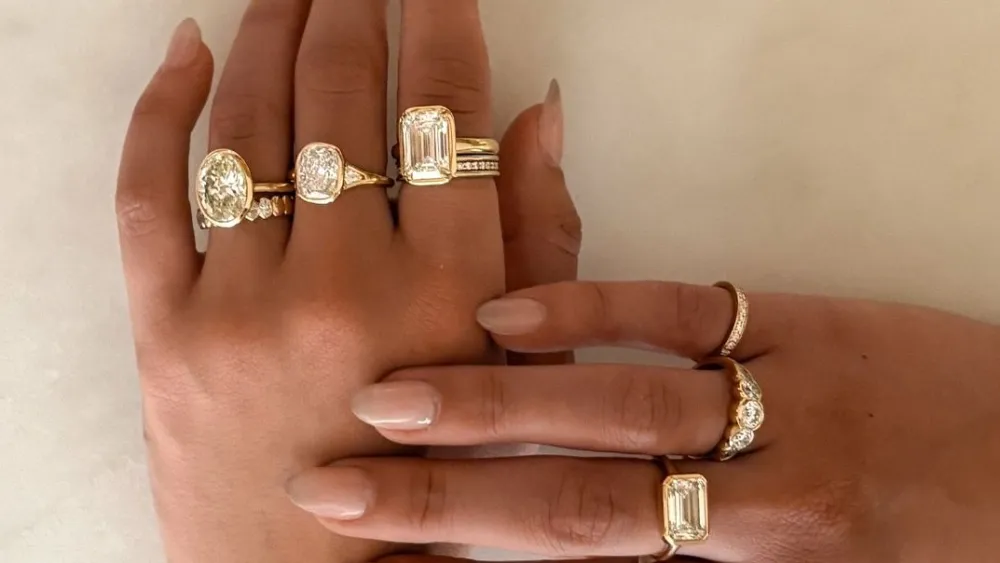
Antique-inspired engagement rings are having a moment — but today’s versions look quite different from the dainty, delicate vintage styles of the past. Instead, the new wave of heirloom-inspired designs embraces larger center stones, chunkier proportions and contemporary settings that feel equal parts nostalgic and fashion-forward. Fueled by celebrity influence and a growing appetite for more individuality in bridal jewelry, the trend is reshaping old-world craftsmanship through a bolder modern lens.
The return of retro, antique engagement rings has been steadily building, but the shift really accelerated after Taylor Swift’s engagement to Travis Kelce, which sparked renewed attention to old-mine diamond cuts and heirloom-style settings. The singer’s antique elongated cushion-cut diamond ring helped push the aesthetic further into the mainstream, signaling that what was once a niche bridal preference is now shaping the direction of modern engagement jewelry.

Taylor Swift’s elongated antique cushion-cut engagement ring from Travis Kelce.
Instagram @taylorswift
“When people saw that elongated cushion cut set simply and intentionally, it gave permission to an enormous group of buyers who wanted something softer and more storied than the rounds and ovals dominating the mainstream market,” says Kegan Fisher, cofounder of Frank Darling. “While we always had buyers interested in elongated cushions, that shape went from about 5 percent of sales to one of our top three shapes over the last year.”
While Swift’s ring carries clear antique inspiration, it also reflects a distinctly modern shift — most notably in its scale. Across the category, engagement rings are notably getting larger, which is serving as an even bigger shakeup in modern takes on vintage-inspired rings. As Fisher notes, the rise of lab-grown diamonds has been a key accelerant. “When you can get a 2.5-carat old mine cut for what a 1-carat mined stone would cost, desire expands accordingly,” she says.

Frank Darling’s Emerald Chiclette Ring features a collet setting, which the brand says is trending in antique-inspired designs.
Courtesy Frank Darling
Historically, shoppers relied on design strategies — halos, clusters and chunkier settings — to create the illusion of size. “But with center stones now more accessible, there’s less need for those workarounds,” Fisher explains. “Instead, we’re seeing bolder, more modern designs that put the diamond itself front and center.”
Design-wise, the new wave of vintage-inspired engagement rings leans into heritage cues rather than strict historical replication. According to Fisher, milgrain detailing, in particular, has emerged as one of the easiest ways to signal vintage influence without tipping into costume. “It’s everywhere. Even a simple milgrain bezel can take a ring from purely modern to modern-vintage, with just the right hint of romance,” she says. Styles like Frank Darling’s Mille Three Stone capture that balance of old and new.

Frank Darling The Millie Three-Stone Ring
Fisher says the same sentiment extends to filigree, which is experiencing a quiet renaissance — particularly in yellow gold. Designers across the category, including brands like Hera Fine Jewelry and Brilliant Earth, are reinterpreting the ornate detailing with a more updated sensibility. Hybrid settings, such as the collet, are also gaining traction in today’s antique-inspired styles, blending bezel and prong construction. “It combines the durability of a bezel with the airy lightness of a prong setting,” Fisher explains. “It’s the jewelry equivalent of having your cake and eating it too.”
Increasingly, though, the most defining shift is happening at the center stone itself. Old mine and old European cuts are moving from niche preference to focal point of design. “Their softer faceting, candlelit glow and slightly irregular geometry feel warm and human in a way that modern brilliant cuts, for all their technical perfection, sometimes don’t,” Fisher says.
Like many fashion cycles, the current revival echoes past vintage moments — but with a noticeably softer, more organic tone. The last major wave, driven by Art Deco references, helped popularize structural elements like the bezel that still influence design today. This time around, however, the aesthetic feels less rigid. “The pendulum is swinging softer,” Fisher says. “We’re seeing ovals, pears, antique cushions, rose cuts and old Europeans — shapes that pair beautifully with the vintage-modern settings gaining momentum right now.”

Frank Darling Juliette Old-Mine Ring
That shift ultimately reflects a broader redefinition of what “vintage” means in bridal jewelry today. Rather than strict reproduction, designers are treating historical references as a starting point for reinterpretation. “We have clients who want the real thing, but just as many who want the feeling of antique jewelry with modern pragmatism: better prong security, lower profiles for wearability, metals that didn’t exist in 1910,” the Frank Darling cofounder says. “What we’re doing — and what the best makers in this space are doing — is treating historic references as a living vocabulary, not a script. You take the milgrain, the soft curves, the romance of old-cut stones, and build something that will last another hundred years. The goal is not reproduction, but continuation.”