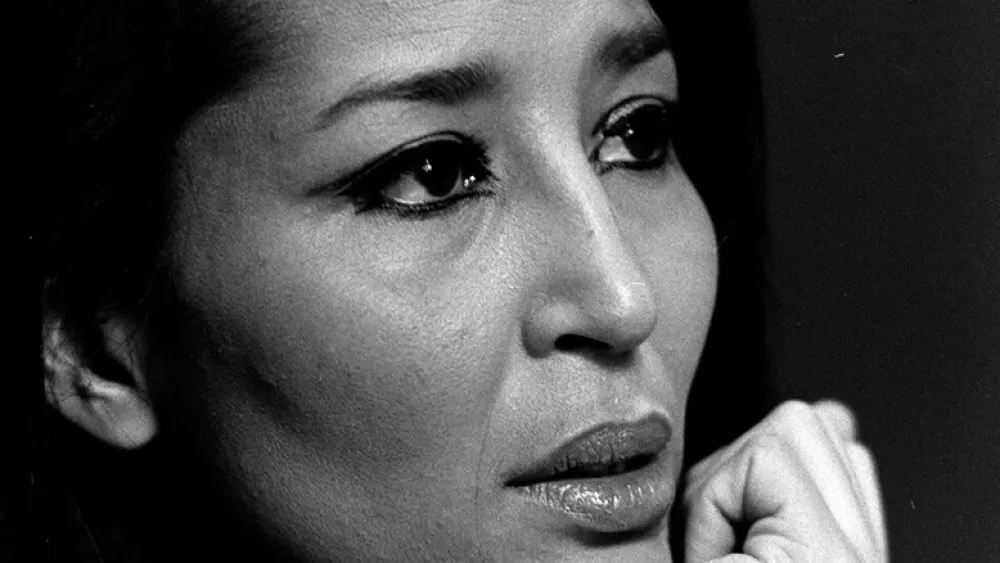
One click of the camera shutter can change everything. For China (pronounced Cheena) Machado, the first model of color to grace the pages of a major magazine, that moment was 1959. The famous shot, taken by legendary fashion photographer Richard Avedon, made her career. “She’s probably the most beautiful woman in the world,” Avedon told Women’s Wear Daily in 1967.
In 1971, Machado was featured on the cover of Harper’s Bazaar; at the time, she was its fashion editor. Both instances were pioneering moments that broke the racial barrier — a conversation fashion still contends with today. To close the monthlong celebration of AAPI Heritage Month, we’re revisiting an interview from 1967, one of many Machado did with WWD and highlighting a few moments that solidified her as a fashion icon.

Bazaar editor China Machado arrives for Jacqueline Kennedy’s One Night Out in New York, 1967. Fairchild Archive/WWD
Fairchild Archive/Penske Media
Born to a Siamese mother and Portuguese father, Machado began modeling in the 1950s after moving to Paris. Within a decade, as she would tell WWD at the time, she worked with Dior, for Balenciaga in Spain, in Italy and exclusively for Givenchy for two years. The timeline easily places her on fashion’s radar. She arrived in New York on the request of Oleg Cassini — famous for wardrobing Jacqueline Kennedy — befriended Diana Vreeland, who introduced her to Avedon, with who she remained friends. She gave up modeling in 1962 to join Harper’s Bazaar, first as a senior fashion editor then as fashion director, working with Avedon on many of the magazine’s defining issues. She would remain at Bazaar for 11 years.

China Machado in New York in 1975 and front row at Pauline Trigere’s spring 1972 fashion show. Fairchild Archive/WWD
Machado didn’t stop there; the multihyphenate — model, editor, designer and television producer — who spoke seven languages, used her moment, transforming her access and passion for the world of fashion into decades of milestones. Many were full circle, as she would return to modeling — she walked the runway during the “Battle of Versailles” for the American designers in 1972 — and designing for her label Cheena over the years.
WWD captured Machado during her most important years, noting her salient opinion on fashion, her life and her many accomplishments. In 1967 she was featured in “The Heiress Apparent,” along with Grace Mirabella. At the time, both were positioned to lead Vogue and Bazaar, two of fashion’s most celebrated periodicals. “Behind every fashion magazine there’s a good woman,” WWD’s Etta Froio declared, but Machado had other plans.
Taken from the pages of WWD below is an excerpt of the interview where Machado answered a few pertinent questions about fashion and her life.

China Machado attends a burlesque-themed benefit for Phoenix House at the Roseland Ballroom in New York City in 1973. Fairchild Archive/WWD
Fairchild Archive/WWD
China Machado: Bazaar wanted an off-beat personality and they thought I was right for the job. It was like joining a family I knew…they were the same people I worked for when I was a model.
I love the theater and movies.…I love parties, hate balls. I love to be with people who think, people who create. I adore to travel…love to dance. I like living.
WWD: What do you think of fashion today…as an editor…as a woman?
C.M.: As an editor, I look at fashion as a newsworthy thing. It’s not just a short skirt or a new fabric…it has gone beyond this. Dresses or costumes by themselves or no longer important. Its accessories, the whole look. Fashion is so much more visual and people in every area have become more fashion conscious. As a woman, I’m lucky…I can always wear everything.

China Machado posing on stage at the Chateau of Versailles during the “Battle of Versailles” on Nov. 28, 1973. Reginald Gray/Fairchild Archive
Fairchild Archive/Penske Media
WWD: What is the most important function of a fashion magazine today?
C.M.: To inspire and influence people…I’m interested in what people are thinking, what they have to say about the magazine. Many ask why we are so way out or why that girl in the photograph looks so ugly. We have to be way out. Fashion has to be exaggerated, has to newsy to get the point across. We don’t have to look today like we did five years ago.

China Machado attends a party at the Roberto Cavalli Madison Avenue store in New York in 2011.
Fairchild Archive/WWD
WWD: If you could start a brand new fashion publication, what type would it be?
C.M.: It would be a magazine — a weekly. It might not have the glossiness of Vogue or the quality of Bazaar, but it would have the beat of what’s happening in the world…something that wouldn’t be thrown away the next day.…It would be specialized…have an immediacy and be fun.
During the same year, Machado again impacted fashion, producing some of the first commercials for AT&T and Virginia Slims cigarettes that successfully changed the visual appeal of high fashion for television. A few years later, she debuted her first of many ready-to-wear collections under the label Cheena. Never completely retiring, Machado stayed within fashion’s and WWD’s lens, returning to modeling at age 81. Proving once again, not just what was possible in beauty through diversity and inclusivity, but what was necessary to keep the conversation moving forward. Machado died in 2016 at the age of 86.