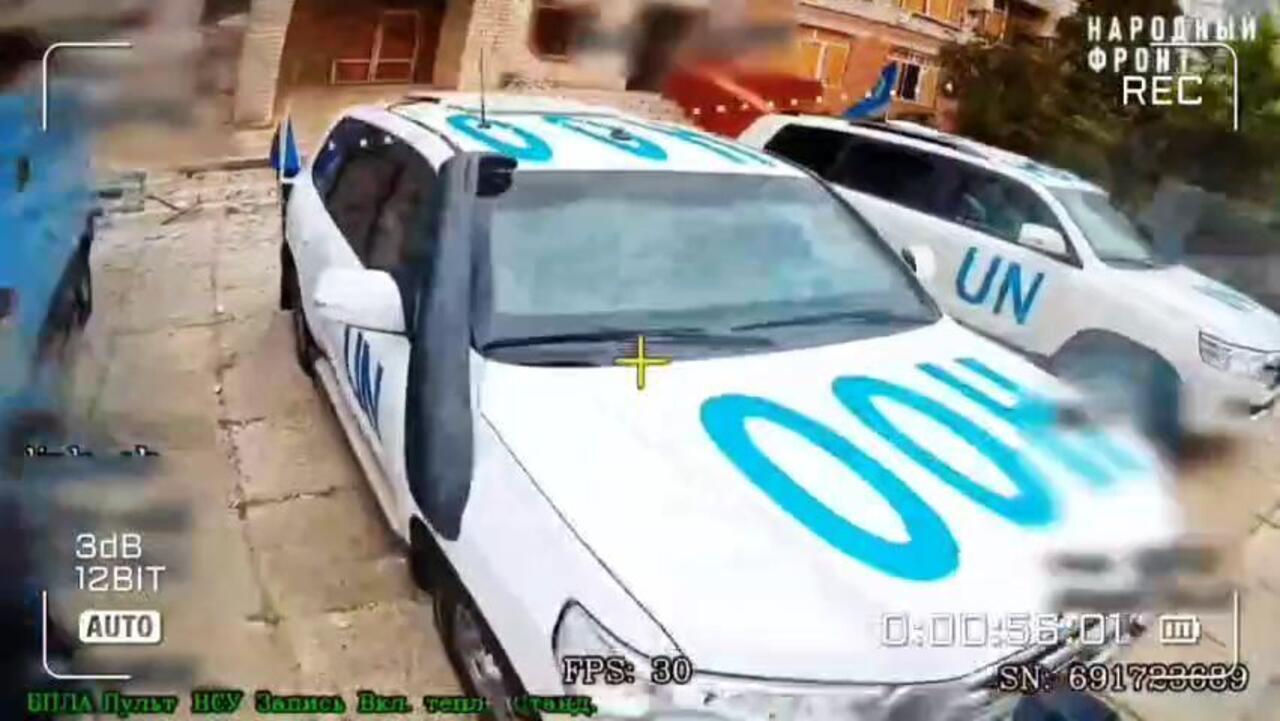
It was 9am on May 14 when an FPV drone slammed into a convoy of white, UN-marked vehicles in southern Ukraine. The targeted humanitarian mission was being carried out by teams from the UN Office for the Coordination of Humanitarian Affairs (OCHA).
The convoy was moving between the cities of Kherson and Ostriv when the Russian kamikaze drone suddenly struck one of the vehicles.
Read moreHow Russian drones are terrorising civilians in Ukraine
‘We didn’t see the drone coming’
The attack occurred as the humanitarian convoy was crossing the bridge connecting Kherson’s port district to the Ostriv neighbourhood. The area sits nearly six kilometres from the nearest Russian positions across the Dnieper River, which separates the two armies.

Andrea De Domenico, OCHA’s head of office in Ukraine, was in the vehicle directly behind the car targeted by the drone. He told our team:
“The first strike hit near a bridge between Kherson and Ostriv around 9am. We knew it was a dangerous crossing – completely open and highly exposed – so we were moving fast. I was filming on my phone to get footage for an update on our mission.
Just as we cleared the bridge, the drone struck the back of the convoy’s lead vehicle. We didn’t see it coming, especially since we didn’t have drone detectors. Fortunately, no one was injured, and we were able to keep driving.”
On May 15, the Telegram channel of Russian military blogger osvedomitell_alex, who shares updates on Russian units in the Kherson region, published the drone footage of the attack. Although the video was later deleted, the post was archived on the TGstat platform, and the footage has since been reposted by another Russian blogger.
The drone footage is unequivocal: it shows the drone hovering over the canals of Kherson’s port before diving toward a vehicle in the convoy crossing the bridge. The UN logo is clearly visible on the door of the white vehicle. The footage has been geolocated by volunteer teams from the GeoConfirmed group.

In the video he posted on May 15, blogger osvedomitell_alex reused the footage captured by Andrea De Domenico, which OCHA had shared on its social media the previous day.
‘The drones were hunting for us’
A second drone strike hit the Ostriv area, located in close proximity to Russian positions. This time, UN vehicles were parked outside a building. As with the first attack, footage captured by Russian drones was shared by osvedomitell_alex and then geolocated by the GeoConfirmed team.
The building where the UN vehicles were parked is a former school that had been repurposed into a humanitarian aid centre.

For De Domenico, this second attack is proof that the UN convoy was deliberately targeted:
“The second strike occurred twenty minutes after the first. They targeted us a second time while we were parked in front of a building where we had just delivered humanitarian aid. We were bringing food to this centre, which locals use to recharge their phones since there is no longer any electricity in Ostriv.
While I was speaking with residents inside the building, there was a loud explosion. My team came to tell me the car had been hit again. At that moment, I realised we had to leave the area, because it was clear that the drones were hunting for us. We finally managed to get away half an hour later.”
‘We gave notice of our mission six days before it began’
In its Telegram post, osvedomitell_alex attempted to justify the strike on the OCHA mission. He claimed that “no official authorisation, notification, or security corridor was received for this ‘humanitarian mission’. In an active combat zone, such vehicles automatically become targets”.
The blogger further argued that the UN vehicles should not have been operating in the area: “Objective control footage clearly shows the vehicle driving through the red zone. Our teams immediately identified it as a priority target and a potentially dangerous object.”
De Domenico said notifying both parties to the conflict is a prerequisite for every mission his teams undertake:
“As always, we notified both parties to the conflict ahead of our intervention. This time, we gave notice of our mission six days before it began. Therefore, everyone had plenty of time to adapt to our presence. Following the attack, we asked the parties what had happened. OCHA is not in a position to attribute the attack to either side, as that is not our role.
But humanitarians are not the only ones being targeted. In Kherson, drone attacks against civilians have become systematic. It is crucial for us to continue supporting the people in this region. In Ostriv, more than two hundred people are living in isolation. Often elderly and destitute, they risk their lives every day because of the drones. They are living without water or electricity. It is therefore vital to speak with these residents to understand why they refuse to leave Ostriv, which is an extremely dangerous locality.
In Kherson, as elsewhere, it is clear that the floodgates of lawlessness have been opened: aid workers are targeted in flagrant violation of international law. Drones are reshaping not only the conduct of war, but also the way crimes against civilians are committed.”
This article has been translated from the original in French.