For summer 2027, Alessandro Sartori found inspiration in a nostalgic Italian ritual, when families would pack up their lives and relocate for the season.
His vision came to life on Malibu Pier Friday evening, where crashing waves and California surfers provided the backdrop. Guests — including Rami Malek, Mahershala Ali and Gael García Bernal — were welcomed with trays of vivid citrus-colored cocktails and rows of striped parasols with matching deck chairs in orange and yellow lining the wooden deck.
As Sartori explained backstage before the show, “La Villeggiatura,” the collection’s title, wasn’t simply about vacations but about bringing your life with you.
“The dog, the grandma, everything,” he said, recalling a time — particularly from the 1950s through the 1970s — when entire families would spend weeks together in rented villas and apartments, gathering around meals and embracing a slower pace of life.
“I still remember even myself, we were going to the seaside in the same place every year for two weeks. The car was so full, and we were bringing everything,” he said.
Sartori noted that the tradition has long been a fixture of Italian cinema and one familiar to the Zegna family.
Building on similar client-focused activations previously hosted in Milan and Dubai, Zegna brought its top clients to Los Angeles for an immersive brand experience. Following the Malibu show, guests gathered at Chateau Marmont, where the collection was displayed across a series of cottages, allowing them to shop the runway looks and place made-to-measure orders. The brand also created a special selection of signature pieces exclusively for the occasion, rendered in materials including vicuña, ultra-fine cashmere and 12-micron wool.
“We have 120 customers that are here tonight — they can buy the collection of the show,” Sartori said. Roughly half were American and, including plus-ones, the guest count reached about 240, he added. “We take care of them for five days.”
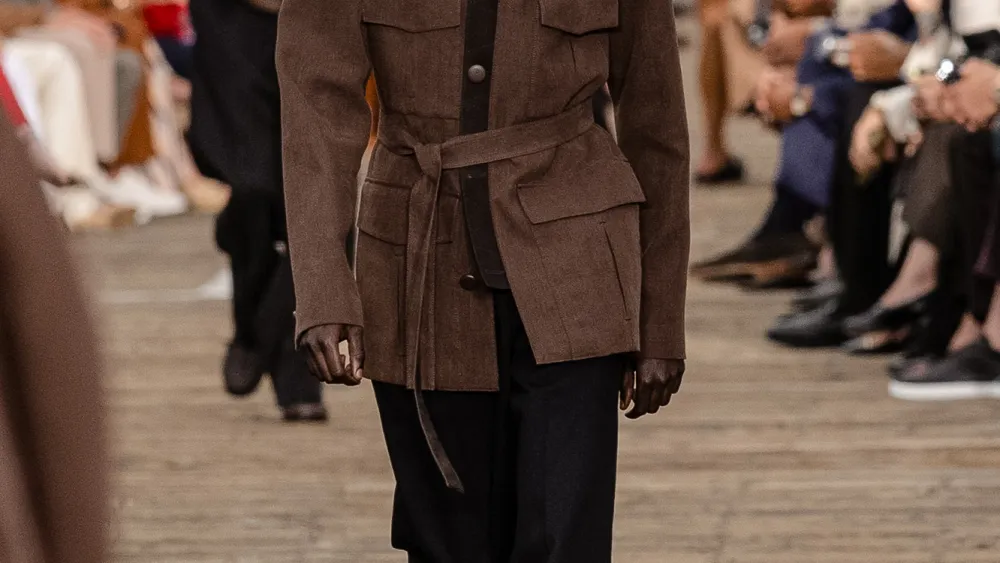
On the runway, Sartori brought a richness to summer dressing without adding weight. Soft tailoring, matching striped separates and lightweight outerwear shaped a wardrobe that felt relaxed yet polished. Belted safari jackets, boxy cropped jackets with dropped shoulders, leather bombers and shirt-jackets appeared throughout the collection, while oversized striped bags, supple loafers and leather slippers completed the looks.
Materials included raw silk, washed hemp, Oasi Lino linen, silk gabardines, seersucker and soft nappa leather, while colors drew from the Mediterranean, spanning ocean blues, rich greens, warm yellows, soft oranges and deep chocolate browns balanced by sandy neutrals.
Sartori highlighted the work of Tessitura Ubertino, a weaving company owned by the group, where vintage jacquard looms from the 1950s and 1960s have been restored and adapted with modern technology to create richly textured fabrics using silk, paper and cotton blends. Many of the collection’s recurring stripe patterns emerged from the process
The designer also revealed a new woven-leather technique developed over more than a year, in which strips of suede and nappa are transformed into yarn before being woven into fabric.
“We wanted to create a leather knitwear,” he said.
The result, much like the collection itself, appeared lighter than its construction might suggest.