The prospect of Moldova unifying with Romania has been raised by Moldovan President Maia Sandu. Andreea Cârstocea writes that while unification could offer Moldova some key advantages, it would be immensely challenging to implement due to the sharp divisions that exist in Moldovan society over the issue.
When the President of Moldova, Maia Sandu, went on the podcast “The Rest is Politics” in January this year and stated that should a referendum on Moldova’s unification with Romania be held, she would vote in favour of it, many were caught by surprise.
For many years, talk of unification had been mostly relegated to the realm of nationalist and far right politicians, so to hear a much respected, liberal politician broach the subject was quite shocking. Yet this comment did not come in isolation. It reflects both Moldova’s geopolitical vulnerability and a sense that public opinion may be shifting on the issue.
Moldova and Romania’s shared history
Present-day Moldova was part of the Romanian principality of Moldavia until 1812, when it became a province of the Russian Empire. It unified with Romania between 1918 and 1940, reverted to Russian control in 1940–41, was again part of Romania after 1941, then formed the Moldavian Soviet Socialist Republic after the Second World War together with Transnistria, a strip of formerly Ukrainian territory.
As part of the Soviet Union, Moldova was subjected to intense Russification. The Romanian language spoken on the territory was renamed by Soviet authorities as “Moldovan”, while the Latin alphabet was replaced with Cyrillic to serve as an identity marker and communication barrier to Romanians in Romania (the Latin alphabet returned in 1989). Talk of reunification emerged again after the fall of communism, however it never materialised.
Connections between contemporary Moldova and Romania go beyond a common language and a shared history. Close to a million Moldovan citizens (out of a total of 2.4 million) also hold Romanian citizenship, including Sandu herself who has dual citizenship. Good relations between the two countries in recent years have even led some to argue that the process of unification is already under way.
Is unification Moldova’s plan B?
Moldova was granted candidate status for EU accession in 2022. Accession remains a key objective for the Moldovan government. In her statement, Sandu acknowledged that the unification of Moldova with Romania would probably not be supported by a majority of Moldovans and described accession to the EU as “a much more realistic goal” that would help protect Moldovan sovereignty.
So why bring unification back up now? One reason is that with a war raging in neighbouring Ukraine and a separatist regime backed by Russia in Transnistria, Moldova is increasingly vulnerable. This was visible in Russian disinformation campaigns during last year’s elections. Moldova is also one of the poorest countries in Europe, leading Sandu to admit that it is “more and more difficult for a small country like Moldova to survive as a democracy… [and] to resist Russia”.
Yet there is a second potential reason that has been put forward by some commentators. This is the idea that by raising the prospect of unification, Sandu is outlining a “plan B” for Moldova’s goal of joining the EU. In other words, should the process of EU accession not go according to plan, a union with Romania could provide an alternative solution to Moldova’s security and economic problems.
A mixed reception
In Moldova, Sandu’s statement was met with a mixed reception. Pro-European politicians – including Moldova’s Prime Minister, Alexandru Munteanu – expressed support for the idea, while others warned of insufficient support within Moldovan society. The Party of Socialists, led by the former President Igor Dodon, demanded Sandu’s resignation as well as an investigation into her statement as possibly constituting an act of “high treason”.
In contrast, the reception in Romania was largely positive. Nicușor Dan, the President of Romania, declared that Romania is ready for unification should Moldova decide it wants to take this step, but also acknowledged the divisions within Moldovan society on the subject.
Other important figures, such as the President of the Romanian Academy, also expressed support, stating this might be the most important historical moment for achieving unification. A month after Sandu’s statement, one of Romania’s far right parties (S.O.S. Romania) went as far as to submit a draft law proposing the unification of the two countries – which was promptly rejected by the country’s Legislative Council.
What do the polls say?
The legal and logistical challenges with unification are hard to overstate, as are the geopolitical implications. But a more fundamental question is whether people in Moldova and Romania would support the process, given both countries would have to hold referendums to amend their respective constitutions.
In Romania, polling evidence is mixed due to different organisations using different methodologies, as well as the general unreliability of opinion polling within the country. A May 2026 poll indicates that 72% of people would support unification, however another poll from late 2025 suggested that only 47% of people would be in favour of it. An additional poll in 2023 put the figure at 33%, while a poll in 2022 found 74.5% would support the process.
In Moldova, there is clearer evidence due to a larger number of polls being conducted on the issue. Several recent polls appear to indicate a growing percentage of the population is in favour of unification. While in previous years support for unification hovered around 30-35%, one poll from 2026 put the figure at 46% support while another recorded 42% support for unification. Another poll from March 2026 indicated that if the diaspora is included, support would surpass 50%.
However, there are sharp divisions in Moldova over the issue. The March 2026 poll shows that while 48% of those who identify as Moldovan or Romanian express support for unification, only 14.5% of those belonging to a minority group support it. This is no trivial matter: the latest census indicated that around 15% of Moldova’s population belongs to a minority (5.1% Ukrainian, 4% Gagauz, 3.4% Russian, 1.6% Bulgarian and 0.4% Roma).
An important factor here is that minorities in Moldova generally use two languages – their mother tongue and Russian. They often have limited proficiency in Romanian and use Russian to communicate with people who do not speak their mother tongue.
This acts as a barrier to inclusion in Moldovan society and increases vulnerability to Russian disinformation campaigns, which in recent years have targeted minority communities to foster internal divisions, fuel separatist sentiments, challenge the European ambitions of the Moldovan government and present Russia as an alternative source of security and prosperity.
Minorities cannot be ignored
Any conversation about unification must consider the interests and concerns of national minorities in Moldova. While unification is still just an idea, there is no doubt that Maia Sandu’s statement has both legitimised the issue and put it squarely on the table. Should unification continue to be pursued, the misgivings of Moldova’s national minorities cannot be ignored.
Several important questions stand out in this context. For instance, what would be the status of Gagauzia, the autonomous unit of Moldova that has a predominantly Gagauz population? Romania has long resisted initiatives aimed at granting autonomy to its ethnic Hungarian communities. Transnistria is another complicated matter – while polling is not generally carried out in Transnistria, it can be safely assumed that support for unification with Romania is extremely limited.
Furthermore, both regions use three official languages – Gagauz, Russian and Romanian in Gagauzia, and Russian, Ukrainian and Moldovan (Romanian) in Transnistria. What would a language policy look like for these regions in the case of unification? And more generally, what would be the status of Moldova’s minorities in such a union?
It is unclear at this point whether unification will remain just an idea or develop into something more concrete. But what is clear is that if steps toward unification are ever to be taken, the concerns of national minorities in Moldova must be considered from the very beginning of the process.
Note: This article gives the views of the author, not the position of LSE European Politics or the London School of Economics.
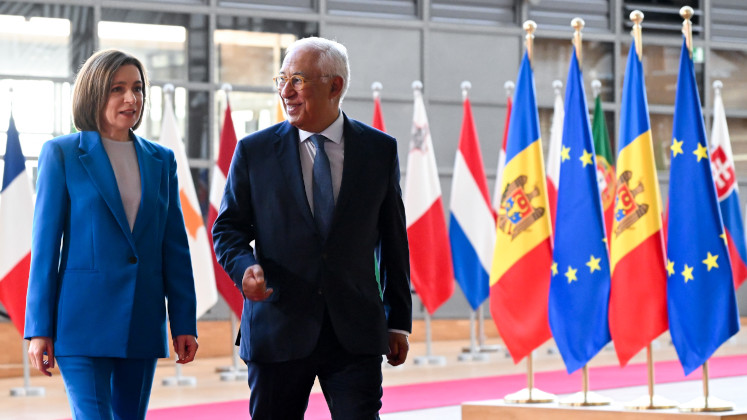
Image credit: European Union.